
 By Eric Ralls | Source
The heart of our Milky Way galaxy is much more active than most people would realize. In fact, astronomers discovered two gigantic “bubbles” extending above and below the galactic center, roughly 50,000 light years in each direction.
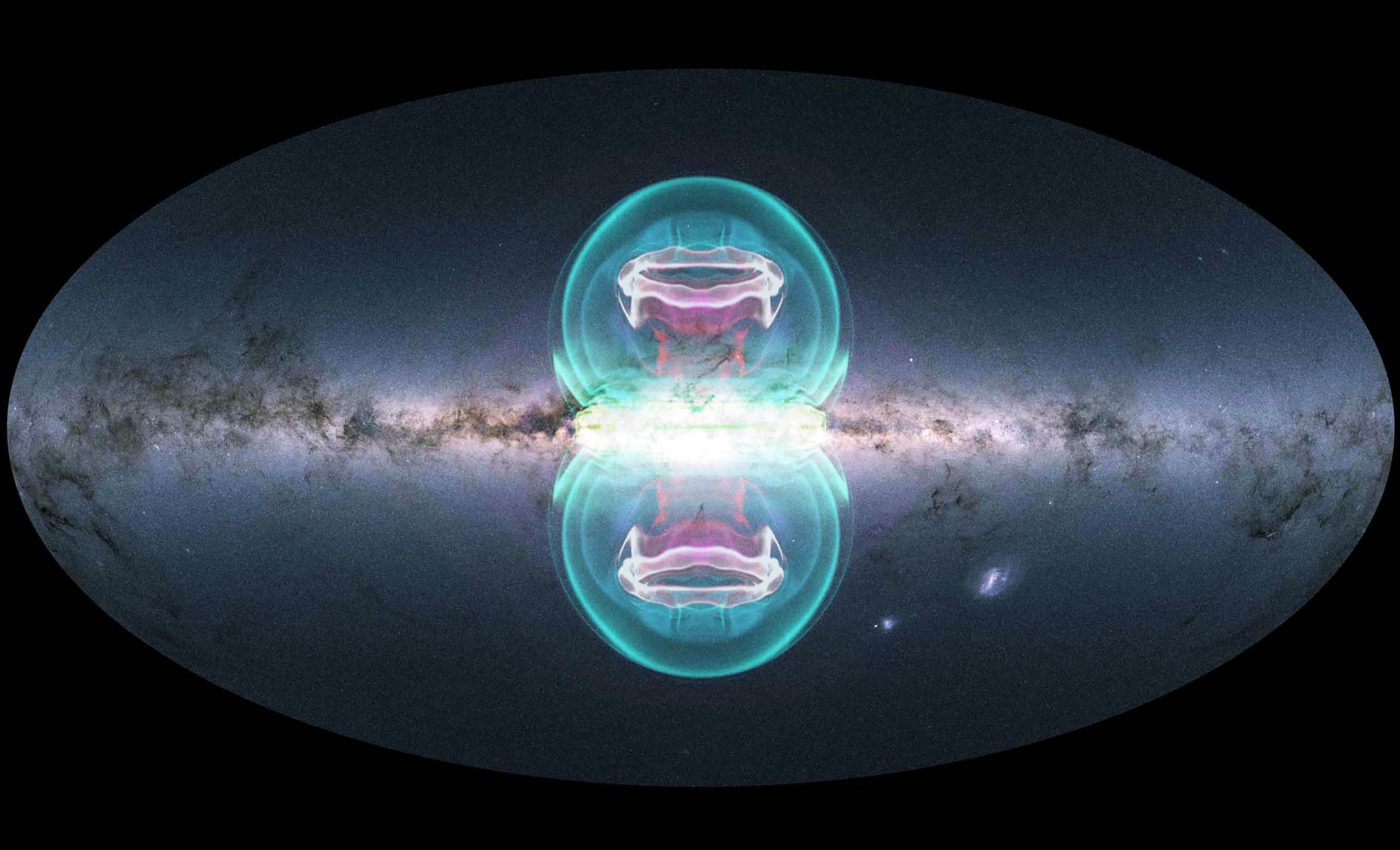
Each one stretches tens of thousands of light-years above and below the galactic center, yet they stay hidden from casual stargazers because they glow mainly in gamma rays and X-rays.
These mysterious formations appear to have emerged from the supermassive black hole at the center of the galaxy, Sagittarius A*.
Researchers pieced together evidence that points to an enormous outburst several million years ago, releasing colossal amounts of energy in a short time.
“Fermi” and “eRosita” bubbles
These enormous structures are called the Fermi and eRosita bubbles, named for the telescopes that found them independently in 2010 and 2020.
Since then, researchers have published well over a hundred peer-reviewed papers that specifically investigate the nature, origins, and implications of the Fermi Bubbles.
One study in particular explores how these bubbles arose and pinpoints the event that may have created them.
It suggests that a powerful jet of material began erupting from the Milky Way’s central black hole, Sagittarius A*, about 2.6 million years ago, continuing for roughly 100,000 years.
Mateusz Ruszkowski from the University of Michigan worked on this investigation alongside partners at National Tsing Hua University in Taiwan and the University of Wisconsin.
“Our findings are important in the sense that we need to understand how black holes interact with the galaxies that they are inside, because this interaction allows these black holes to grow in a controlled fashion as opposed to grow uncontrollably,” said U-M astronomer Mateusz Ruszkowski, a co-author of the study.
“If you believe in the model of these Fermi or eRosita bubbles as being driven by supermassive black holes, you can start answering these profound questions.”
Galaxy bubbles and black hole jets
The research indicates that a black hole outflow can blow away surrounding gas and inflate these bubbles rather than letting the black hole grow without limits.
This idea contrasts with an older hypothesis that connected the bubbles to supernova-driven starbursts.
The new results back the black hole scenario instead, helped by observations of a microwave haze and other emissions near the galaxy’s center.
“We not only can rule out the starburst model, but we can also fine tune the parameters that are needed to produce the same images, or something very similar to what’s in the sky, within that supermassive black hole model,” Ruszkowski said.
“We can better constrain certain things, such as how much energy was pumped in, what’s inside these bubbles and how long was the energy injected in order to produce these bubbles.”
Cosmic rays and expanding gas
The eRosita and Fermi bubbles each shine in different wavelengths, but they appear related to the same violent release of energy.