
 By Sonya Crittenden | Source
In 2020, Americans spent a mind-blowing $823 million on melatonin supplements alone, a 43% increase from 2019. (Daignaut 2021)
Like other supplements, melatonin exploded in popularity during the COVID-19 pandemic, as many Americans suffered from stress-related insomnia and other sleep-related disturbances.
Millions of Americans are turning to Melatonin as a “natural” alternative to sleep aids … but is it safe?
Endogenous melatonin is a hormone produced by the pineal gland in the brain and helps to regulate the body’s internal clock, called the circadian rhythm. The circadian rhythm is a 24-hour cycle that regulates various internal processes, including the sleep-wake cycle, body temperature, metabolism, and digestion. (Garcia 2020)
Melatonin’s job is to tell the body when these cycles start and stop in a 24-hour period. For example, endogenous melatonin tells the brain when it is time to go to sleep, and when it is time to wake up.
However, despite confused reports, melatonin plays no role in the quality, depth, or overall restfulness of sleep. Endogenous melatonin is like a shift manager, regulating the body’s sleep cycles, while the quality and restfulness of sleep are regulated by other parts of the brain. (Crist 2022)
Although melatonin is thought to help with sleep issues, it is not effective for chronic insomnia, restless sleep, frequent nighttime waking, or other troubles with sleep at night.
Melatonin Deficiency is Uncommon
It is also important to know that most people are not melatonin deficient. When one takes a supplement, the assumption is that the body is deficient in this substance. By consuming the supplement, the identified deficiency is filled so that one’s overall health does not suffer. But what happens if the body is not actually deficient?
Melatonin deficiency is uncommon and is usually caused by specific factors that do not apply to most people who take melatonin supplements. Melatonin deficiency is typically the result of:
-
Smoking (nicotine use)
-
Excessive alcohol consumption
-
Excessive caffeine consumption
-
Shiftwork (evening or nighttime work shifts)
-
Frequent time zone changes (i.e., jet lag)
Unless one meets one or more of the above qualifiers, it is highly unlikely that they are melatonin deficient. If you take melatonin supplements when you do not actually need them, you are overdosing your brain and body on this hormone.
If using supplements as a sleep solution sounds like a bad idea, it most likely is.
Since melatonin regulates the timing of important cycles such as metabolism and the release of hormones, melatonin supplements can interfere with the natural regulation of these cycles. Interference with the body’s natural metabolic and hormonal cycles can lead to weight gain and fertility problems. (Garcia 2020)
A common argument for the safety of melatonin is that it is “natural.” As a society, we often mistake “natural” as meaning “safe”.
Just because something is natural does not mean it is safe, nor does it mean it is good for you.
Opium, cocaine, nicotine, and even arsenic are all “natural” substances. However, while these substances are natural, they are decidedly not safe for human consumption.
While melatonin produced by the brain is “natural,” melatonin supplements are produced synthetically in a lab, using various chemical compounds. Despite how they are promoted, melatonin supplements are not “natural”. Other dietary supplements that are also promoted as “natural” such as GABA, Theanine, and Tryptophan are also produced synthetically.
When considering the overall safety of supplements and natural remedies vs. over the counter and prescription medications, one must also consider the potential side effects. Below are two lists of common side effects. One list is from a popular prescription drug called Prozac, while the other list is from a popular melatonin supplement.
Can you guess which list of side effects belongs to which product?
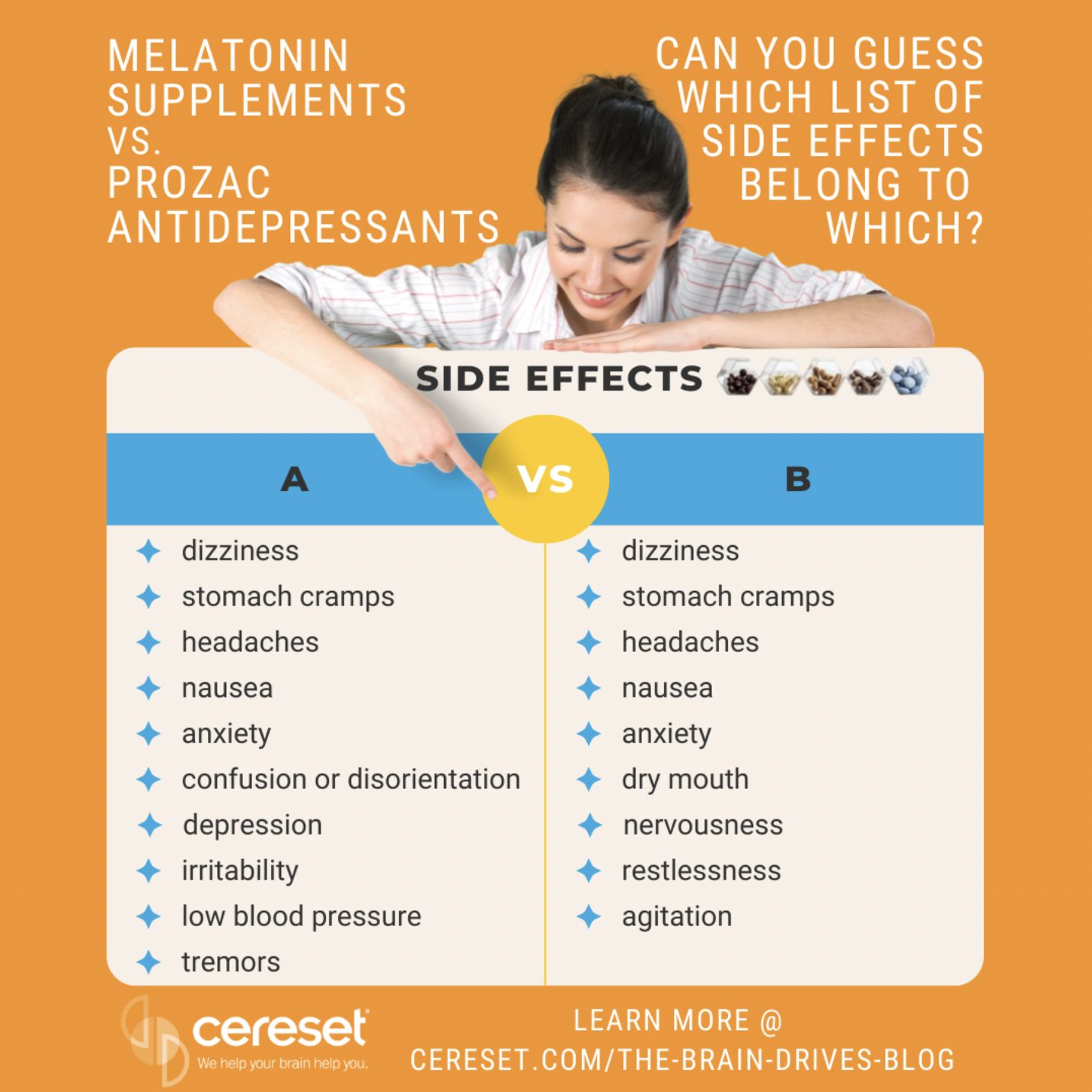
List A above belongs to a popular melatonin supplement, while list B belongs to the antidepressant Prozac. However, the active ingredients caused little to no difference between melatonin side effects and prescription Prozac side effects. One might wonder if supplements are actually “safer” or “better” for them than prescribed drugs, if the impact on their body is nearly the same.
While the federal Food and Drug Administration (FDA) carefully monitors and controls the development and production of prescription drugs, there is little to no oversight of supplements and minimal safety protections for consumers.
In 2017, a study was conducted on thirty-one different melatonin supplements that were available for purchase. Alarmingly, most of the supplements were found to have “widely varied” levels of melatonin than what was advertised on their labels.
Even more disturbing, 26% were found to also contain serotonin. Serotonin is another important brain hormone that, if taken too much, can cause long-term damage to the brain and even death. (Alaska Regional Hospital 2020)
The bottom line is, there is currently no way to know for sure what is in any supplement, including the strength, quality, and safety of the ingredients used.
Since more people are taking supplements, it is important to ask questions about their safety and effectiveness. The truth is often much more complex and nuanced than what is presented in the media.
What we understand is this: the brain is a highly intricate, extremely complex, and infinite system. In fact, there are more connections in the brain than there are stars in the observable universe. The brain is vast and complex, and there is still much we do not understand about how it works. Yet, we can be quite reckless in our exploration and control of the brain.
The truth is, it is impossible to know how adding a foreign substance to the brain will impact it, so we encourage our clients to do their own research, trust their own instincts, and treat their brain with the respect, care, and awe it deserves.
For those experiencing sleep problems consider this:
Awhile back I watched a presentation by a brain specialist who’s been treating dementia successfully for 25 years using magnesium.
As most of the world is deficient in magnesium, I decided to up my intake and not lose my marbles. Of his two recommendations, I chose magnesium l threonate.
What I wasn’t prepared for was how deeply this would impact my sleep. I sleep well always but the threonate has given me the most amazing deep sleep I’ve had since a child. Given the opportunity I could sleep 9-10 hours. I recommended this to a friend and both he and his wife had the same experience..
The doc recommended one in the morning and one at night for dementia 2000mg. I’ve found that two taken after dinner with fat is stellar for amazing sleep.
I called them. I have injuries that make sleep difficult. They give 5 free sessions to veterans. Thanks for posting this KR.
Hi Pal, I am not sure I got you. I got that you have sleep problems, so do I. But are you against Melatonin ? Well, one can’t be knowleadgable about everything, and I don’t spend a lot of time about health related topics.
So, so far, for me, it went well (I am taking melatonin since a few weeks) , or maybe it’s just my Uranus transit going slowly away. But please, share what you do know about it, if you will, I am not sure I got you right, and I am open-minded on this topic.
On another note, are you a wounded military veteran ?
Hi Raksha, I took melatonin for a while and experienced many of the side effects mentioned in this article. I know some people say it works for them, but I’m no longer comfortable taking it. We know too little about all the effects and interactions.
I don’t mean to discourage you from taking it if you feel it’s working. (It’s certainly better than using sleep drugs.) Take care.
Hi Lyra,
Take magnesium, 50mg a couple hours before bed. You can increase the dose if that’s not enough. Give it two or three days for it to get in your system.
Kejraj, thank you! That is very useful.
Sleep is a problem for me. They do however want quite a bit of scratch for this brain biofeedback tech.